Recognize
What is Hazing?
Under the Stop Campus Hazing Act, hazing is defined as:
Any intentional, knowing, or reckless act — whether done alone or with others — that is committed against someone in connection with joining, maintaining, or affiliating with a student organization, and that causes or creates a risk (beyond typical college activities) of physical or psychological harm.
It doesn’t matter if the person agrees to participate — hazing is still hazing.
Examples of Hazing
What Does Hazing Look Like?
Hazing isn’t always obvious—it can take many different forms. Whether physical, emotional, or psychological, hazing puts people at risk and violates Emory’s policies. Here are some common examples:
Physical Abuse
- Hitting, beating, or shocking
- Putting harmful substances on someone’s body
Forced Physical Exertion or Isolation
- Intense or excessive workouts
- Sleep deprivation
- Being locked in small spaces
- Being left outside in bad weather
Forced Consumption
- Being pressured to drink alcohol or use drugs
- Eating or drinking strange or excessive items
Sexual Coercion
- Being pressured or forced to perform sexual acts
Verbal or Psychological Harm
- Intimidation or threats of physical harm
- Using fear or humiliation to control someone
Illegal Activity
- Forcing someone to break the law
- Pressuring someone into criminal acts
Remember: If something feels off, it probably is. Hazing isn’t just a “rite of passage”—it’s harmful, unsafe, and not okay.
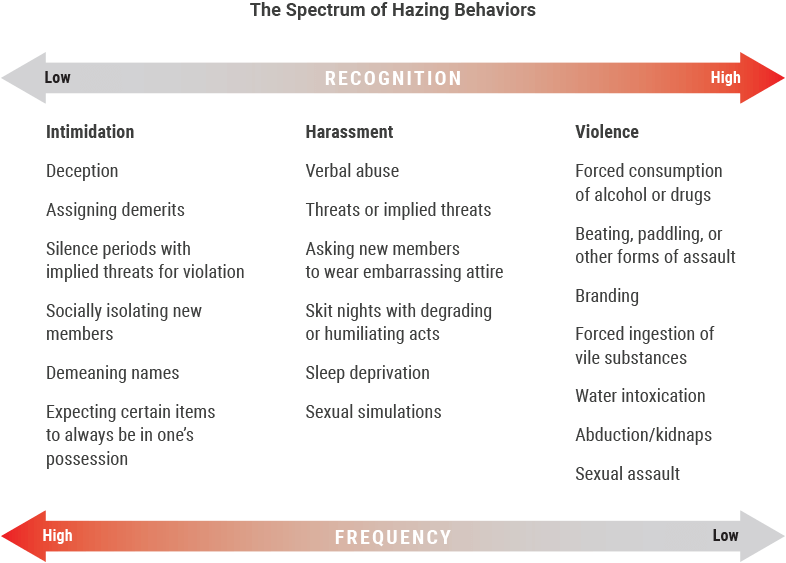
Spectrum of Hazing
Hazing can take many forms. Researchers Dr. Elizabeth Allan and Dr. Dave Kerschner created The Spectrum of Hazing™ to explain how hazing behaviors are often categorized as “subtle,” “harassment,” or “violent.” While some actions may seem minor or harmless, they can still cause harm and are often overlooked—making them more common. More obvious or extreme behaviors tend to happen less frequently because they’re easier to recognize and call out.
The more we understand and recognize the full spectrum of hazing, the better we can prevent it and step in when needed. Everyone deserves to feel included without being harmed.
Hazing is prohibited by the University Policy and Georgia Law
Policy and Laws
Policy 8.11
Policy 8.11 outlines Emory’s commitment to preventing hazing and supporting a safe, respectful campus environment.
Here’s what it covers:
What Counts as Hazing: Clear definitions and examples to help students understand what hazing looks like—both obvious and subtle.
Education & Prevention: Emory provides resources and training to help students recognize and prevent hazing behaviors.
Reporting & Accountability: The policy explains how to report suspected hazing and details the process for investigation and disciplinary action.
Important: This policy applies to everyone—students, faculty, staff, and even visitors. We all have a role in keeping our community safe and inclusive.
The Stop Campus Hazing Act
The Stop Campus Hazing Act (SCHA) is a new law designed to make college campuses safer by improving how schools report and prevent hazing. Backed by safety experts, national fraternity/sorority organizations, and families of hazing victims, the law ensures students and families have the information they need to make informed choices.
What does the law do?
Increases Transparency: Colleges must include hazing incidents in their Annual Security Report (also known as the Clery Report), so students know what’s happening on campus.
Prevents Harm: Schools are required to implement campus-wide hazing prevention and education programs based on research and best practices.
Keeps You Informed: Colleges must clearly share their hazing policies and publicly list any campus organizations that have violated them.
This law is a step toward creating safer, more accountable, and more supportive college communities.
Max Gruver Act
Under the Georgia Anti-Hazing Law, also known as the Max Gruver Act, hazing is a crime, and students who engage in it can face serious legal consequences.
According to Georgia law (O.C.G.A. § 16-5-61), it is unlawful to haze any student as part of an initiation or affiliation into a student organization — even if the person consents.
Criminal Penalties
Misdemeanor charges for acts of hazing that cause a risk of harm
Felony charges if the hazing results in serious bodily injury or death
This means that students involved in hazing — whether planning, participating, or failing to intervene — can face arrest, prosecution, and potential jail time.
At Emory, hazing is also a serious conduct violation, which may lead to suspension or even expulsion.